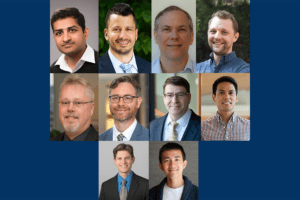
Markita Landry and Eunyong Park receive 2026 MTI Parkinson’s Therapeutics Awards

Parkinson’s disease afflicts more than ten million people worldwide, and with prevalence continuing to rise, the need for therapies that do more than merely mask symptoms has become urgent. In response, UC Berkeley’s Molecular Therapeutics Initiative (MTI) has selected three research teams for the inaugural MTI Parkinson’s Therapeutics Program, launched last autumn to transform high-impact academic…

A collage of John Clarke featured alongside excerpts from an annual report to BES sharing the results on macroscopic quantum tunneling and energy-level quantization in a superconducting circuit, along with a 1999 photo of Klaus Schlenga next to a SQUID Magnetic Resonance Imaging System.

How John Clarke’s Nobel Prize-Winning Research Paved the Way for Quantum Computing

Key Takeaways John Clarke, a former scientist at Berkeley Lab, shared the 2025 Nobel Prize in Physics for discovering quantum tunneling in an electric chip. This research, conducted at Berkeley Lab in the 1980s by Clarke and co-laureates Michel Devoret and John Martinis, was supported by the Department of Energy’s Office of Science. The team’s…

illustration of proteins on a black background.

Researchers uncover new rules for designing protein-like polymers

Findings could lead to eco-friendly plastics and other materials UC Berkeley professor Ting Xu has spent more than seven years trying to figure out how to design synthetic polymers with protein-like behaviors. Now, she and a team of researchers have unlocked “design rules” that upend long-held views on polymers and could pave the way for eco-friendly plastics…

Nicole King leans against a bench in her UC Berkeley lab.

Did the first animal look like a sponge or a comb jelly? The debate continues.

Two years ago, a novel analysis by UC Berkeley researchers pointed to comb jellies as the root of the animal tree of life. Another Berkeley group now says it’s sponges. Photo by Alison Yin, courtesy of HHMIBiologists who study the evolutionary origin of animals got a bit of a surprise this month when a new…

Hand getting water from faucet.

Testing the waters

Worldwide, more than 500,000 children under age five die each year from gastrointestinal bacterial infections, largely in communities lacking safe drinking water, sanitation and hygiene infrastructure. To address this public health threat, scientists need to better understand how these pathogens spread. Now, a team led by Amy Pickering, associate professor of civil and environmental engineering, has discovered…

Dan Fletcher.

National Academy of Medicine adds two from UC Berkeley to its ranks

The new members have worked on mobile phone microscopes and health disparities. The National Academy of Medicine has added two UC Berkeley faculty members to its ranks of scholars, the academy announced Monday. Election to the academy is considered one of the highest honors in the fields of health and medicine, recognizing individuals who have…

John Clarke sitting in a sunny room.

John Clarke, UC Berkeley emeritus professor, awarded 2025 Nobel Prize in Physics

The Nobel Prize committee honored Clarke “for the discovery of macroscopic quantum mechanical tunneling and energy quantization in an electric circuit.” These circuits were forerunners of the qubits in many quantum computers. John Clarke, an emeritus professor of physics at the University of California, Berkeley, was awarded the 2025 Nobel Prize in Physics for his…

A woman looking at the camera with an inset image of the Ebola virus.

Berkeley microbiologist explains the wonder of viruses in 101 seconds

  For many people, viruses are a scourge; they cause illness and even death, and the mere mention of them, whether they are harmless or cause the flu, sends many reaching for the disinfectant wipes. But to Britt Glaunsinger, viruses are a wonder. “I love efficiency, and viruses are masters at efficiency,” says Glaunsinger, a professor…