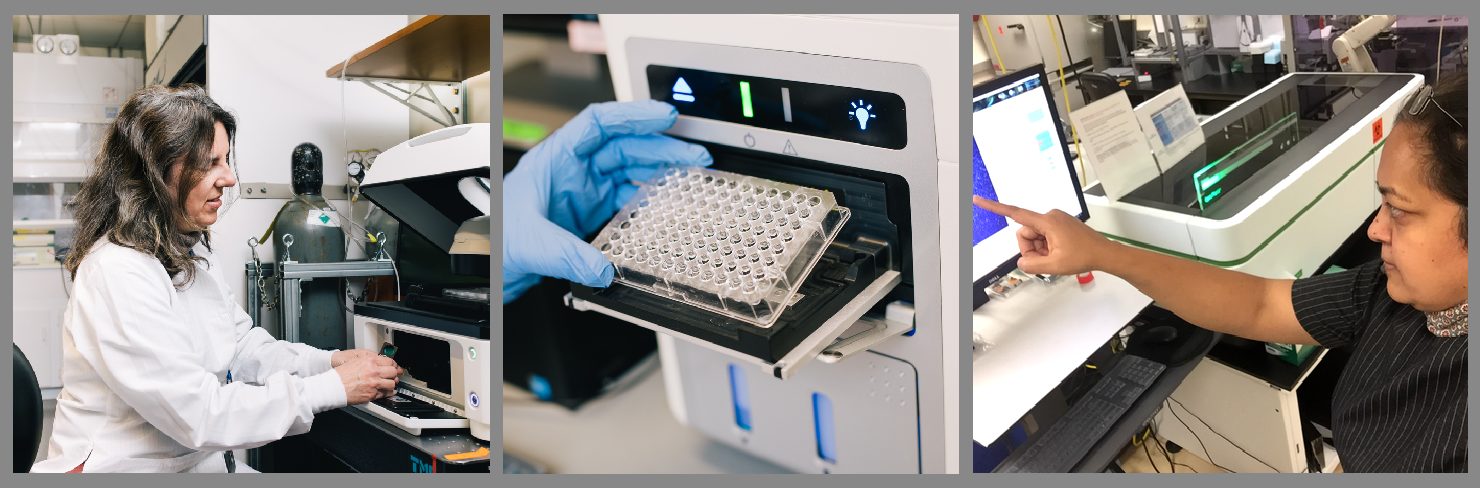
The QB3 Cell and Tissue Analysis Facility provides cell culture equipment and instrumentation needed to grow and assess mammalian cells including flow cytometry, automated epifluorescence, confocal, and multiphoton imaging, as well as a histology suite with cryosectioning equipment. The High-Throughput Screening Facility provides expert staff for training, services, and cell culturing space for HT automated library screening and cell seeding. Liquid handling equipment, multi-label plate reader and high-content automated confocal imaging for any type of multi-well, multi-conditional mammalian cell experiments are also available.
The QB3 Cell and Tissue Facility (CTAF), located in Stanley Hall, provides a full service cell culture room with equipment and instrumentation for researchers to grow and assess mammalian cells to further their research. Instruments include flow cytometry, Luminex Xmap multiplex immunoassay system, qPCR, hypoxia chambers, micromanipulator, protein quantification, and liquid handling automation. There are microscopes for fixed and live cell automated epifluorescence, confocal, and multiphoton imaging. Tissue related instrumentation includes cryostats, sliding microtome, paraffin-embedding equipment, and histology processing and staining setup.
The High-Throughput Screening Facility (HTSF), located in the Li Ka Shing Center for Biomedical and Health Sciences, is unique in providing researchers hands-on access to liquid handling automation in a core facility environment. Expert staff provide training on use of the cell culturing space, automated liquid handling, automated plate reader and high-throughput, high-content Opera Phenix confocal microscope with robotics for any size multi-conditional screening and validation experiments. The microscope provides high quality single or Z-stack images of 2D/3D based multi-well plate and slides with followup software tools for complex image analysis and bioinformatics assessment. We assist with some siRNA and arrayed CRISPR screening reagents, CRISPR cell line identification, along with other high-throughput fluidics projects. We also provide a lentivirus packaging service, and an amplification service, providing maxipreps of DNA and specialized CRISPR libraries with full validation, upon request.
Now, in partnership with IGI’s Center for CRISPR Target Discover (CCTD), the HTSF and CCTD together can provide for the following: custom CRISPR screening project design, CRISPR pooled screening or arrayed phenotypic screening by sg/siRNAs, custom library cloning, validation assays, daughter plating, stable cell line assessment and isolation, small molecule drug screening, and dose response assay.
Rates – CTAF
| General CTAF instrumentation use | $36/hr |
| Specialized CTAF Equipment (BioPlex, Refeyn) | $54/hr |
| Long-Term Imaging Microscopes, Cell Culturing, Histology | $123/day |
| Custom | $100/hr |
| Storage, LN2 box | $5/month |
Non-UC Rates
| General CTAF instrumentation use | $155/hr |
| Specialized CTAF Equipment (BioPlex, Refeyn) | $200/hr |
| Long-Term Imaging Microscopes, Cell Culturing, Histology | $441/day |
| Custom | $253/hr |
| Storage, LN2 box | $8/box |
For information on additional equipment options, or QB3-Berkeley Startup Partner rates and application instructions, please email Mary West.
Rates – HTSF
HTSF rates effective July 1, 2026
| University of California Rates | |
| Item | Hourly Rate |
| Opera Phenix Automated Microscope | $75 (30 min minimum) |
| Envision Plate Reader | $120 (8 min minimum) |
| Agilent V11 Bravo | $263 (30 min minimum) |
| Rainin MicroPro 300 | $33 |
| BioMek NXP, Rainin Benchsmart, Agilent MultiFlo | $130 (30 min minimum) |
| Cell Culture Hood, Custom | $16 (60 min minimum) |
| Staff Services | $102 |
| Analysis Access | $11 |
| Weekly Screening Access | $929/week |
| Viral Packaging | $696/standard quantity |
| Materials Markup | 15% |
| Non-University of California Rates | |
| Item | Hourly Rate |
| Opera Phenix Automated Microscope | $122 (30 min minimum) |
| Envision Plate Reader | $196 (8 min minimum) |
| Agilent V11 Bravo | $447 (30 min minimum) |
| Rainin MicroPro 300 | $55 |
| BioMek NXP, Rainin Benchsmart, Agilent MultiFlo | $226 (30 min minimum) |
| Cell Culture Hood, Custom | $26 (60 min minimum) |
| Staff Services | $176 |
| Analysis Access | $24 |
| Weekly Screening Access | $1579/week |
| Viral Packaging | $1176/standard quantity |
| Materials Markup | 15% |
Please email Pingping He to find out more about special pricing for longer term plate reader and Opera Phenix use; QB3-Berkeley Startup Partner criteria and available pricing; and other services.
General citations
QB3 CTAF or HTSF acknowledgement: We thank [staff names here] of the [Cell and Tissue Analysis Facility (CTAF) or High-Throughput Screening Facility (HTSF)] at UC Berkeley. This work was performed in part in the [QB3 CTAF or HTSF], that provided the [name specific instrument used].
NIH citations for use of the Perkin Elmer Opera Phenix at the HTSF
Each publication, press release, or other document about research supported by an NIH award must include an acknowledgment of NIH award support and a disclaimer such as “Research reported in this publication was supported by the Office of the Director, National Institutes of Health, under Award Number S10OD021828. The content is solely the responsibility of the authors and does not necessarily represent the official views of the National Institutes of Health.”
Prior to issuing a press release concerning the outcome of this research, please notify the NIH awarding IC in advance to allow for coordination.
The QB3 Cell and Tissue Analysis Facility (CTAF) is directed by Professor Matthew B. Francis, Department of Chemistry. Professor Michael Rape, Department of Molecular and Cell Biology, serves as a scientific adviser for the HTSF.
Dr. Mary West is the director of the CTAF and provides support to the HTSF. Dr. Alice Refermat is the HTSF scientific director. Dr. Pingping He is the HTSF manager.
The CTAF is located in UC Berkeley’s Stanley Hall in the northeast area of the campus. The HTSF is located primarily in UC Berkeley’s Li Ka Shing Center for Biomedical and Health Sciences in the northwest area of campus.
Visit QB3-Berkeley’s core research facilities to learn more about these facilities that serve the Bay Area scientific community.
Learn about other campus research facilities that may have some complementary capability to the CTAF, HTSF, and CCTD for your research:
Contact
| Mary West QB3 CTAF Director | B108 Stanley Hall |
| Matthew B Francis QB3 CTAF Faculty Director | 608B Stanley Hall |
| Alice Refermat QB3 HTSF & IGI CCTD Scientific Director | 2151 Berkeley Way, UC Berkeley |
| Pingping He HTSF Manager | 344 Li Ka Shing Center |